 English
  Magyar
In this guide What does hotel revenue management mean?
Hotel revenue management means selling the right room to the right guest, at the right price, through the right channel and at the right time. For an independent hotel, it is a repeatable way to connect data, demand, pricing, distribution and review, not just a spreadsheet exercise or a last-minute rate change.
This guide explains the complete cycle, the decisions behind it and the measures that keep it on course. It is designed as a practical starting point rather than an exhaustive manual for every specialist topic.
What does hotel revenue management mean?
Revenue management uses evidence to improve the profitable revenue earned from a perishable product: rooms. Once a night has passed, an unsold room cannot be sold again. The aim is therefore to shape demand before the arrival date, rather than reacting only when occupancy looks high or low.
The objective is not simply to fill every room. A full hotel at heavily discounted rates can generate less contribution than slightly lower occupancy at stronger rates, particularly after commission and variable servicing costs. Good hotel revenue management considers the value and cost of demand as well as its volume.
For an independent hotel, the process can be practical and proportionate. It requires agreed data, clear decision rights and regular review, rather than a large team.
Start with data you can trust
Revenue decisions depend on consistent inputs. A hotel does not need perfect systems to begin, but it does need information that explains past performance, current bookings and likely future demand.
Start with data from the property management system (PMS), booking engine, channel manager and finance records. Useful fields include room nights, room revenue, average daily rate (ADR), occupancy, cancellations, lead time, segment, booking source and no-shows. Add local context such as events, school holidays, transport disruption and relevant weather-sensitive demand.
Review data by arrival date. A monthly average can hide a soft Sunday, a compressed Saturday and a conference-driven Tuesday. Before acting, check for duplicate reservations, rooms taken out of inventory, incorrect segment codes, missing cancellations and inconsistent channel mapping. A precise forecast built on poor data still produces a poor decision.
Technology can support revenue optimisation and reduce manual work, but the question is not whether every task can be automated. It is which checks should be automated, which exceptions need investigation and which decisions still require human judgement.
Forecast demand before it becomes obvious
Forecasting connects raw data to action. It estimates future demand by arrival date, segment and booking pace. The result helps the team decide whether to hold rate, stimulate demand or protect space for higher-value bookings.
- On-the-books business: rooms and revenue already booked for each future date.
- Pickup: the net change in bookings over a defined period, including cancellations.
- Pace: how current bookings compare with a genuinely similar period or prior forecast.
- Unconstrained demand: estimated demand if capacity did not impose a limit.
- Booking behaviour by segment: differences in lead time, cancellation patterns and length of stay.
- Market context: events, holidays, local activity and relevant competitor signals.
A coastal hotel, city townhouse and rural wedding venue will not share the same demand curve. Choose comparable dates with care, especially when events or the day of week have changed. The core habit is simple: examine future dates while there is still time to act.
Use simple segmentation to judge the value of demand
Segmentation groups bookings that call for different commercial decisions. A small independent hotel rarely needs a complex model. Start with three to five useful groups, such as direct leisure, OTA leisure, corporate, groups or events and packages.
These groups may differ in lead time, cancellations, length of stay, price sensitivity and acquisition cost. Create a separate segment only when it changes a pricing, distribution or availability decision. For example, weak Sunday demand may call for a targeted direct offer rather than a discount across every channel.
Set prices with a reason, not a reflex
Hotels should set prices according to demand, value, booking pace and market context. Competitor rates are useful context, but they do not reveal another hotel’s cost base, guest mix, reputation, room types or booking terms. A competitive pricing analysis should compare like with like and support a decision, not replace one.
- A rate ladder: agreed price points for low, medium, high and peak demand.
- Room-type supplements: consistent differences between standard, family, superior and feature rooms.
- Channel economics: commission and acquisition costs considered alongside headline rate.
- Value-added offers: packages that add appeal without automatically cutting the room rate.
- Discount rules: agreed triggers and boundaries for reducing price.
If pickup is ahead of forecast and demand is strong, the hotel can raise rates while rooms remain available. If demand is weak, first ask whether the cause is price, visibility, restrictions, proposition or the market itself. Cutting the rate will not solve every problem.
RoomRaiser revenue-management check
Take our quick self-assessment to see where your revenue-management routine stands today and which areas are worth strengthening next.
Interactive self-assessment
How consistent is your revenue routine?
Score each statement 0 for not yet, 1 for sometimes or 2 for consistently.
Use restrictions carefully
Restrictions help shape demand. They include minimum length of stay, closed-to-arrival or closed-to-departure controls, advance-purchase conditions, cancellation terms and limits by channel or segment.
Used well, these controls can protect valuable availability. If Saturday demand is strong but Friday is soft, a two-night minimum might build weekend revenue. If a low-rated group requests peak dates far in advance, a smaller allocation may leave room for later, higher-value demand.
Controls can also turn away valid bookings. A minimum stay may leave rooms empty if shoulder-night demand does not materialise, while rigid cancellation terms can weaken conversion. Apply each restriction to a specific problem, set a review date and remove it when the conditions change.
Make the strategy bookable through the right channels
Distribution is where the plan becomes visible to guests. Rooms may be sold through the hotel website, OTAs, metasearch, corporate agents, wholesalers, event partners, telephone or email. Each route reaches different demand and carries its own costs and conditions.
OTAs can provide useful reach, while direct bookings give the hotel more control over the guest relationship. The aim is not to label one channel as universally good or bad. It is to use each one deliberately by date, segment and need period.
Rates, availability, room descriptions, images and policies must remain accurate across channels. Review the net value produced by each channel, not only gross room revenue.
How hotel systems can reduce manual revenue work
Managing revenue by hand means collecting data from several sources, checking competitor rates and updating many future dates. This takes time and can delay reactions to pickup, cancellations or market changes.
A property management system (PMS) stores reservations, availability and stay data. A channel manager keeps rates, availability and restrictions aligned across connected sales channels. A revenue management system (RMS) analyses relevant hotel and market data, helping the team focus on dates that need attention.
RoomRaiser supports this workflow with automated analysis and rate recommendations guided by hotel-defined rules. Depending on the configuration, recommendations can be reviewed, adjusted or sent to connected systems, while the hotel retains control over pricing decisions.
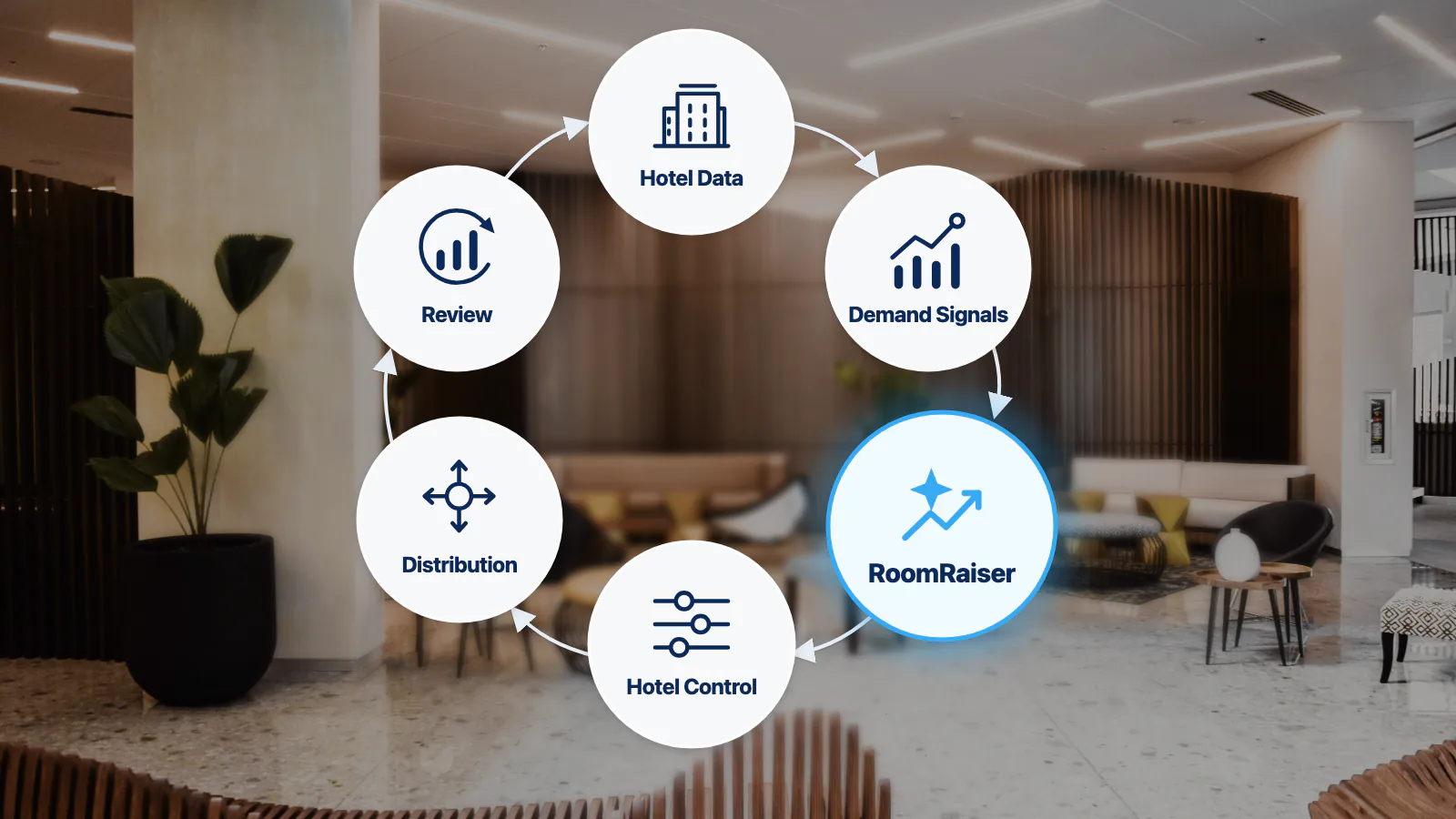
The precise data flow and automation level depend on each property’s configuration and integrations. Before implementation, confirm field definitions, update frequency, failure alerts, permissions and the system that acts as the source of truth.
Begin with supervised automation while data quality is uncertain, integrations are newly connected or an exceptional event is affecting demand. Move towards automatic updates only after the team understands the recommendations and knows how to intervene.
Track hotel performance metrics together
No single measure tells the whole story. Use a small group of hotel performance metrics and interpret them alongside segment and channel mix.
Occupancy
rooms sold ÷ rooms available Shows inventory use, but not the rate achieved or the cost of the booking channel.
ADR
room revenue ÷ rooms sold Shows the average achieved rate, but not unsold capacity.
RevPAR
room revenue ÷ rooms available Combines rate and occupancy, but excludes distribution and operating costs.
Net contribution
revenue − relevant variable and acquisition costs Supports channel decisions, but should not be treated as accounting profit.
Bringing these measures together can become time-consuming when data is spread across different systems. This is the problem RoomRaiser BI is designed to solve: it gives teams a shared view of available commercial metrics without rebuilding the same reports each time. The value of that view still depends on connected systems, agreed definitions and data quality.
Read the measures together. High occupancy with weak ADR may indicate over-discounting, while RevPAR can rise even as channel costs reduce the net benefit.
Review performance and clarify responsibility
Revenue management improves through regular review. After each week, month or key trading period, compare the forecast with actual occupancy, ADR, RevPAR, cancellations, conversion, channel cost and segment mix. Record the reason behind important decisions.
- Which dates differed from the forecast, and why?
- Which segments and channels delivered the strongest net value?
- Did pricing or restrictions help, and what should change next?
Assign one person to maintain the forecast and decision log, with named owners for rates, channel accuracy and commercial actions. Systems provide information, but accountability remains with the hotel team.
Illustrative weekly decision: one Saturday, one controlled choice
The following scenario is illustrative and does not describe a RoomRaiser customer result. All monetary figures are shown in GBP, but the same decision logic applies in other markets and currencies.
Illustrative scenario
A local event has reduced competitor availability. After checking the data, the team raises the flexible rate to £160 and removes an unnecessary OTA promotion. It keeps the direct offer visible and does not impose a minimum stay because Friday and Sunday remain soft.
The decision is recorded and reviewed again in three days. The team can then raise the rate again, hold it or restore selected value. This is one controlled decision built from data, forecast, price, channel and review.
RoomRaiser in practice: one workflow across five properties
A Lake Balaton operator introduced RoomRaiser across five properties of 20–50 rooms. In the first year, the group reported 11% revenue growth and an increase in revenue-related profit margin from 9.2% to 12.4%. Automated rate recommendations and competitor monitoring reduced manual work while the operator retained control over pricing decisions.
Where to start in the next 30 days
Week 1: establish the baseline. Agree definitions for rooms available, room revenue, segments and channel costs. Correct obvious inventory, mapping and coding issues.
Week 2: build the forward view. Create a simple arrival-date forecast for the next 90 days. Mark events, record on-the-books rooms and revenue, and choose relevant comparison dates.
Week 3: set decision rules. Define rate levels, discount boundaries and who can change prices or restrictions. List the signals that trigger a review rather than an automatic response.
Week 4: close the loop. Hold a structured commercial review. Record actions, owners, reasons and review dates. Complete the RoomRaiser check again, then choose one weakness to improve next.
Frequently asked questions
What is the main goal of hotel revenue management?
To improve profitable revenue by balancing price, demand, availability, distribution cost and timing, rather than simply maximising occupancy.
Can a small independent hotel use revenue management?
Yes. Start with clean data, a simple forecast, clear pricing rules and a weekly review suited to the hotel’s scale.
How is revenue management different from dynamic pricing?
Dynamic pricing changes rates; revenue management also covers forecasting, segmentation, restrictions, channels and performance review.
Does a hotel need an RMS to start?
No. Begin manually; consider software when the volume and frequency of decisions become difficult to manage consistently.
The practical takeaway
Hotel revenue management works as a shared commercial habit. Reliable data shows the position, forecasting creates a forward view, and segmentation, pricing, restrictions and distribution turn it into action. Review then improves the next cycle.
Keep the process visible and proportionate. A consistent weekly decision rhythm is stronger than a complicated process the team cannot maintain.